


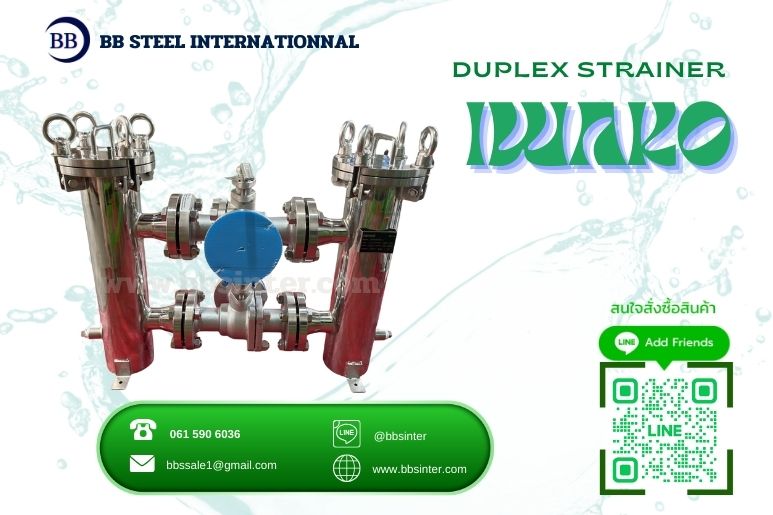
Duplex Strainer in Raw Water Intake Systems
Duplex Strainer Installation in Raw Water Intake and Early-Stage Treatment Lines : In raw water systems, average water quality is not the primary risk factor. The real operational exposure comes from sudden solids loading, seasonal debris surges, and unstable hydraulic behavior. These conditions do not degrade the system slowly; they impose abrupt stress on pumps, valves, and treatment components.
A duplex strainer installed in raw water intake and early-stage treatment lines is not intended to refine water quality. Its function is to control hydraulic instability and prevent mechanical consequences both upstream and downstream. The engineering justification for its use must be evaluated at system level, not as an isolated piping component.
Duplex Strainer Function in Raw Water Intake Systems
Raw water commonly carries suspended solids, organic debris, sand, silt, shell fragments in brackish or sea sources, and seasonal algae blooms. The operating challenge is variability. Solids concentration can change rapidly, and debris events often occur without gradual warning.
Failure modes in this environment are typically characterized by:
-
Rapid differential pressure increase
-
Flow restriction
-
Escalation of pump loading
-
Potential cavitation risk
-
Blockage of sensitive downstream equipment
These effects are interconnected. As debris accumulates inside the basket, differential pressure rises. Rising differential pressure restricts flow and alters system hydraulics. Pumps experience increased loading, and if suction pressure falls, cavitation risk intensifies. Downstream components that cannot tolerate obstruction may be exposed if filtration is compromised.
A simplex strainer requires shutdown during cleaning. In raw water service, where debris events are unpredictable, this interruption can destabilize the entire process line. A duplex strainer allows basket switching under flow. Hydraulic continuity is maintained while one chamber is isolated for cleaning.
From a system perspective, the duplex configuration is selected to eliminate flow interruption during debris events. Its value lies in continuity under unstable raw water conditions.
Installation Location
1 Installation Upstream of Sensitive Equipment
Typical protection targets include:
-
Pump internals when installed on the discharge side
-
Control valves with narrow trim
-
Flow meters
-
Chemical injection quills
-
Static mixers
-
Early-stage membrane or filtration components
The objective is direct: prevent large debris from reaching components that cannot tolerate obstruction. Where these elements are vulnerable to solids, upstream duplex strainer installation provides controlled interception.
The decision is not about maximizing filtration. It is about protecting equipment that would otherwise experience mechanical or operational degradation.
2 Suction-Side Installation and NPSH Evaluation
Installing a duplex strainer on pump suction requires disciplined analysis. As debris accumulates:
-
Differential pressure increases
-
Suction pressure decreases
-
NPSH margin is reduced
If NPSH available approaches NPSH required, cavitation risk increases sharply. The relationship is immediate and mechanical. Reduced suction pressure directly affects pump stability.
Therefore, suction-side installation must include:
-
Hydraulic margin analysis
-
Evaluation of strainer pressure drop under fouled conditions
-
Alarm setpoints defined before NPSH margin is compromised
This evaluation is a system-level calculation. It cannot be treated as a simple piping arrangement. Without this analysis, the duplex strainer intended to protect equipment may create a cavitation risk upstream.
Why Duplex Is Preferred in Early-Stage Treatment Lines
Early-stage treatment systems often depend on:
-
Minimum continuous flow rate
-
Stable hydraulic loading to downstream processes
-
Controlled chemical dosing proportional to flow
Any interruption, even temporary, can produce level instability, process imbalance, chemical dosing errors, and downstream quality deviation.
A simplex strainer introduces operational discontinuity because cleaning requires isolation of the line. In contrast, a duplex strainer provides redundancy at the filtration point. One chamber can remain in service while the other is cleaned.
However, redundancy is conditional. It exists only if:
-
The changeover valve seals properly
-
Switching is executed correctly
-
Isolation procedures are disciplined
In duplex systems, the valve assembly becomes the critical reliability component. If it fails to align, seal, or operate as intended, the expected redundancy is lost. The filtration body may be sound, yet system continuity may still be compromised.
Differential Pressure Management as the Core Control Variable
In raw water service, duplex strainers must be managed by measured differential pressure. Flow observation alone is insufficient.
Minimum engineering configuration includes:
-
Pressure gauge upstream
-
Pressure gauge downstream
-
Calculated differential pressure (ΔP)
Operational logic should incorporate:
-
High ΔP alarm
-
Rapid ΔP rise alarm indicating debris surge
If operators respond only after flow decreases, the system has already entered a stressed condition. Elevated differential pressure is an early indicator. Managing ΔP allows controlled switching before hydraulic performance degrades.
Differential pressure is therefore not a secondary measurement. It is the primary operational parameter governing duplex strainer performance.
Mechanical Installation Considerations
1 Maintenance Clearance
2.Drain and Vent Provisions
3.Structural Support
Corrosion and Erosion Considerations
Raw water environments are frequently corrosive, abrasive, and biologically active. Sand causes erosion at velocity change points. Salinity accelerates corrosion. Biological activity introduces additional surface exposure concerns.
The duplex strainer housing functions as both:
-
A pressure boundary
-
A wear component
Material selection and inspection intervals must reflect actual water chemistry and solids content. The mechanical integrity of the housing and basket depends on realistic assessment of these conditions.
Filtration Rating Strategy in Early-Stage Lines
In early-stage treatment, the objective is not fine filtration. The objective is equipment protection without inducing premature clogging.
If mesh is too fine:
-
Differential pressure increases rapidly
-
Cleaning frequency rises
-
Operational burden increases
If mesh is too coarse:
-
Downstream components remain exposed
Filtration rating must correspond to:
-
Debris characteristics
-
Sensitivity of downstream equipment
-
Available maintenance capacity
The correct balance protects equipment while maintaining operability.
System-Level Pre-Installation Checklist
Before finalizing duplex strainer installation in raw water intake or early-stage treatment lines, confirm:
-
Fouled-condition pressure drop does not compromise pump NPSH.
-
Differential pressure monitoring is installed and alarmed.
-
Changeover procedure does not induce hydraulic shock.
-
Drain and vent connections are included.
-
Maintenance clearance is physically verified.
-
Structural supports isolate loads from nozzles.
-
Material selection reflects actual water chemistry.
-
Downstream equipment vulnerability is clearly defined.
These confirmations convert a component decision into a system-level reliability decision.
A duplex strainer in raw water intake and early-stage treatment lines is not a convenience device. It is a hydraulic stability and equipment protection component.
If installed without pressure-drop analysis, NPSH evaluation, disciplined changeover logic, and maintenance access planning, it can accelerate failure rather than prevent it.
When engineered correctly, it maintains hydraulic continuity during debris events and stabilizes early-stage treatment performance under variable raw water conditions.
That is the engineering basis for its installation.
Engineering Discussion
For technical discussion regarding system integration or configuration review, reference:
-
Industrial Duplex Basket Strainer “IWAKO”
-
Duplex Basket Strainer Carbon Steel
-
Duplex Basket Strainer Stainless Steel
Engineering evaluation should be based on hydraulic conditions, operational constraints, and maintenance strategy rather than catalog comparison.
🏣 BB STEEL INTERNATIONNAL
☎️ Tel. 061 590 6036
🆔Line ID : @bbsinter ( https://lin.ee/BKzpb1L )
📧E mail : bbssale1@gmail.com
🌐: www.bbsinter.com
Author Profile
Latest entries
 level gaugeสิงหาคม 24, 2026Industrial Welding Pad Level Gauge Supplier “IWAKO”
 level gaugeสิงหาคม 21, 2026Water Liquid Level Gauge Cock Stainless Steel “IWAKO”
 strainer filterสิงหาคม 17, 2026Automatic water filter used for water treatment
 strainer filterสิงหาคม 17, 2026Automatic self-cleaning filters IWAKO ระบบบำบัดน้ำเสียและน้ำบริสุทธิ์ที่โรงงานไว้วางใจ

