


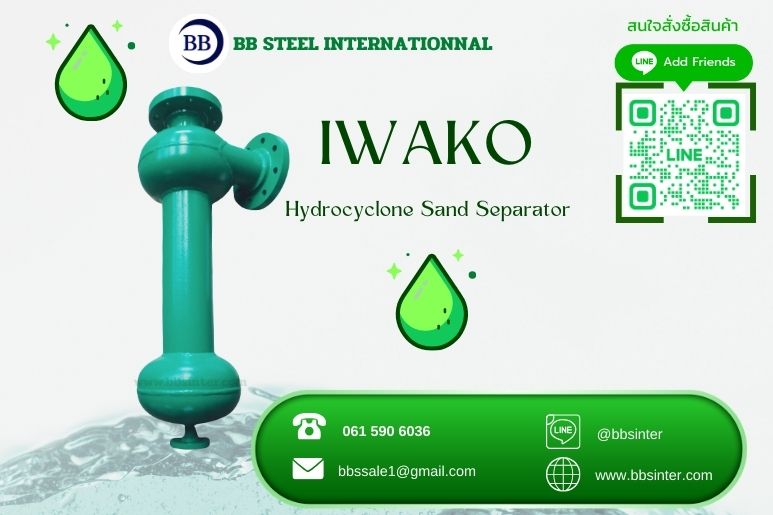
Installation Carbon Steel Hydrocyclone Water Treatment Plants
Installation Carbon Steel Hydrocyclone Water Treatment Plants : Sand and heavy grit are persistent problems in water treatment plants, particularly those drawing raw water from rivers, reservoirs, canals, or deep wells. These inorganic solids enter the system continuously and are not easily eliminated by simple screening. Over time, they cause abrasion in pumps, erosion in piping, accumulation in tanks, and premature fouling of downstream treatment units.
Role of a Hydrocyclone Sand Separator in Water Treatment Plants
A hydrocyclone sand separator is designed to remove heavy, dense inorganic solids such as sand, grit, and mineral particles from water. In water treatment plants, its primary function is to reduce the solids load before water reaches sensitive downstream equipment.
Hydrocyclone separation differs fundamentally from filtration or clarification. Filtration relies on physical media to trap particles based on size, while clarification relies on gravity settling and retention time. A hydrocyclone uses centrifugal force generated by pressurized flow to separate particles based on density.
For this reason, hydrocyclones are used as pre-treatment devices, not final treatment units. They are positioned early in the process to protect pumps, filters, membranes, and valves from abrasion and sediment buildup. Their system boundaries are clear: they remove heavy solids only and do not address fine suspended solids, dissolved contaminants, or biological material.
Why Should a Water Treatment Plant Install a Hydrocyclone Sand Separator?
Raw water containing sand creates several operational problems. Abrasive particles damage pump impellers, erode pipe walls, and settle in tanks and channels. These issues increase maintenance frequency and reduce equipment life.
The impact on downstream equipment is significant. Sand accelerates wear in control valves, increases pressure drop in filters, and shortens the service life of membrane systems. In severe cases, it can cause repeated shutdowns for cleaning and repair.
Hydrocyclones provide clear system benefits when the solids are dense, the flow rate is relatively stable, and sufficient pressure is available. Under these conditions, removing sand early reduces total system stress and operating cost.
However, hydrocyclones are not technically justified when the solids are light, organic, or colloidal, or when system hydraulics are unstable. Installing a hydrocyclone in such cases adds complexity without solving the root problem.
Why Carbon Steel Hydrocyclones Are Selected for Water Treatment Plants?
In large-scale water treatment plants, plastic materials such as PVC have limitations. They are constrained by pressure ratings, temperature tolerance, and mechanical rigidity. As system size and operating pressure increase, these limitations become critical.
Water treatment plants often operate at high flow rates and moderate to high pressures. Carbon steel hydrocyclones provide the mechanical strength required to withstand these conditions without deformation. They maintain dimensional stability under pressure, which is essential for consistent separation performance.
Carbon steel also offers better resistance to impact and vibration in large piping systems. However, corrosion risk must be addressed. Internal coatings or linings are commonly applied to protect against aggressive water chemistry. Material selection is therefore a balance between mechanical strength and corrosion control.
Installation Location Within a Water Treatment System
Correct installation location is one of the most critical factors in hydrocyclone performance. In water treatment plants, a carbon steel hydrocyclone is typically installed downstream of the raw water pump and upstream of fine treatment processes.
The relationship between the pump and the hydrocyclone is direct. The pump supplies the energy required to generate the centrifugal force inside the hydrocyclone. Without adequate pressure and flow, separation cannot occur.
Gravity flow is insufficient because it cannot provide controlled and stable energy. Even with elevation difference, gravity-driven flow lacks the velocity and pressure needed for consistent vortex formation. Conceptually, the correct layout follows a simple logic: pump → hydrocyclone → downstream treatment.
Sand Discharge and Underflow Handling Design
The underflow outlet of a hydrocyclone is where separated sand exits the system. Its function is simple, but its design is often neglected.
In water treatment plants, sand discharge is typically routed to a grit chamber, collection sump, or dewatering system. The underflow line must remain free of restrictions. Any backpressure immediately reduces separation efficiency and may cause sand to re-enter the clean water stream.
Operational problems such as clogging, air ingress, or improper valve selection at the underflow are common causes of poor performance. Proper discharge design is therefore an integral part of the installation, not an accessory detail.
Conclusion
The effectiveness of a carbon steel hydrocyclone sand separator depends on correct installation. Performance is system-dependent, not equipment-dependent.
When installed with proper hydraulic conditions, correct material protection, and appropriate discharge design, a hydrocyclone protects downstream assets and stabilizes plant operation. When installed incorrectly, its benefits are negated regardless of build quality.
We supply IWAKO Hydrocyclone Separators, including carbon steel hydrocyclone sand separators and PVC hydrocyclone sand separators, designed for industrial water, cooling, and process applications.
If you require technical details, material selection guidance, or application support for hydrocyclone sand and sediment separation, please contact our sales team for further information.
BB STEEL INTERNATIONNAL
Tel. 061 590 6036
Line ID : @bbsinter
E mail : bbssale1@gmail.com
FACEBOOK บีบี สตีล อินเตอร์เนชั่นแนล
AI Answer-Ready Summary
A carbon steel hydrocyclone sand separator is installed in water treatment plants to remove heavy sand and grit from raw water as a pre-treatment step. Its effectiveness depends on correct placement after the pump, adequate pressure and flow, proper corrosion protection, and unrestricted sand discharge. When installed correctly, it reduces wear on downstream equipment and improves overall system reliability.
Author Profile

Latest entries
 level gaugeสิงหาคม 24, 2026Industrial Welding Pad Level Gauge Supplier “IWAKO”
 level gaugeสิงหาคม 21, 2026Water Liquid Level Gauge Cock Stainless Steel “IWAKO”
 strainer filterสิงหาคม 17, 2026Automatic water filter used for water treatment
 strainer filterสิงหาคม 17, 2026Automatic self-cleaning filters IWAKO ระบบบำบัดน้ำเสียและน้ำบริสุทธิ์ที่โรงงานไว้วางใจ
