


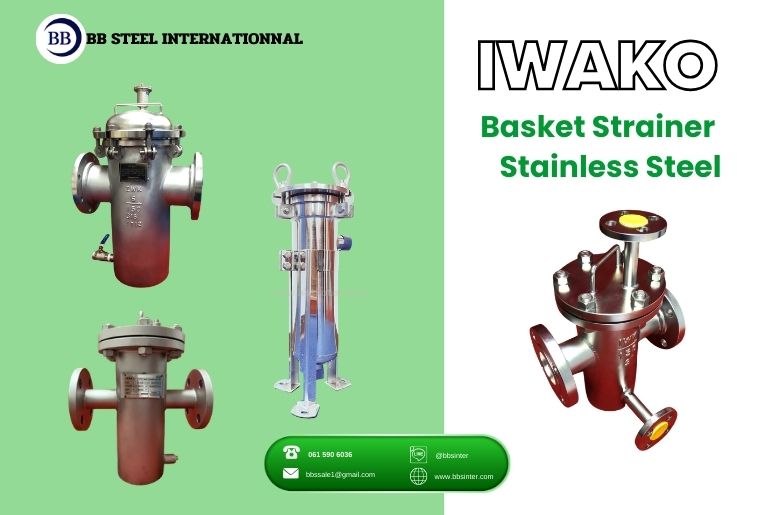
Stainless Steel Basket Strainer Industry “IWAKO”
Stainless Steel Basket Strainer Industry “IWAKO” : A basket strainer stainless steel unit is a filtration device installed in a piping system to remove solid particles from process fluid. It uses a removable basket screen housed inside a pressure-retaining body.
1. Basic Specification of Basket Strainer Stainless Steel
When specifying a basket strainer stainless steel unit, the following technical parameters define the equipment.
1.1 Construction Material A stainless steel configuration may include:
-
Stainless steel body and cover
-
Stainless steel basket or screen
-
Stainless steel bolting and internal components
Material selection must be defined clearly. In some applications, only the basket is stainless steel. In others, the entire assembly is stainless steel.
1.2 Pressure Rating The body must withstand the system’s maximum operating pressure. Pressure rating must be compatible with:
-
Line pressure
-
Temperature conditions
-
Mechanical loads during operation
1.3 Temperature Rating Operating temperature directly affects material strength and sealing performance. The specified temperature range must match process conditions.
1.4 Filtration Degree The basket screen defines particle retention capability. Common screen configurations include:
-
Perforated plate
-
Perforated plate with mesh lining
-
Wedge wire construction
Filtration selection depends on required particle size retention.
1.5 Connection Type Basket strainer stainless steel units may use:
-
Flanged connections
-
Threaded connections
Connection selection must align with pipeline design and pressure class.
1.6 Basket Structure Engineering evaluation includes:
-
Structural rigidity
-
Support ring design
-
Proper seating within the body to prevent bypass
The basket must withstand differential pressure without deformation.
2. Advantages of Basket Strainer Stainless Steel
2.1 Corrosion Resistance Stainless steel offers resistance to corrosion in various industrial environments. It performs effectively in applications involving:
-
Water systems
-
Certain chemical services
-
Chloride-containing fluids
-
Moist or outdoor installations
This reduces the risk of internal material degradation that can compromise sealing surfaces or structural integrity.
2.2 Reduced Contamination Risk In processes where contamination must be controlled, stainless steel minimizes the risk of rust or scale detachment from internal surfaces. This is critical in applications where downstream equipment must remain free from metallic debris.
2.3 Durability Under Repeated Maintenance Basket strainers require periodic opening for cleaning. Stainless steel construction improves resistance to:
-
Surface wear
-
Thread damage
-
Corrosion at gasket seating areas
This supports long-term mechanical reliability during repeated maintenance cycles.
2.4 Structural Stability Stainless steel provides mechanical strength suitable for pressurized systems. When properly designed, the body and basket maintain dimensional stability under operating pressure and differential pressure loads.
3. Benefits in Industrial Operation
From a system perspective, basket strainer stainless steel units provide measurable operational benefits.
3.1 Protection of Downstream Equipment By removing solid particles, the strainer protects:
-
Pumps
-
Control valves
-
Flow meters
-
Heat exchangers
-
Spray nozzles
This reduces the risk of blockage, erosion, and performance instability.
3.2 Predictable Pressure Behavior As solids accumulate, differential pressure increases in a predictable manner. This allows maintenance teams to monitor system performance and schedule cleaning before flow performance is affected.
3.3 Service Life in Corrosive Environments In corrosive service conditions, stainless steel construction reduces deterioration compared to non-resistant materials. This supports longer service intervals and stable sealing performance.
4. Suitable Fluid Applications
Basket strainer stainless steel units are appropriate for fluid services where corrosion resistance and contamination control are important.
4.1 Water Systems
Applicable in:
-
Process water
-
Cooling water
-
Industrial water supply
Particularly beneficial when corrosion risk exists due to dissolved salts or environmental exposure.
4.2 Chemical Fluids
Used in selected chemical services where stainless steel compatibility is suitable for the specific fluid.
Material grade must match chemical properties to ensure long-term resistance.
4.3 Chloride-Containing Fluids
Chloride presence increases corrosion risk. Stainless steel selection must consider exposure level and operating temperature.
4.4 Oil and Hydrocarbon Systems
Applicable where contamination control and mechanical protection of equipment are required.
4.5 Condensate and Elevated Temperature Fluids
In systems involving condensate or elevated temperatures, stainless steel construction supports resistance to corrosion associated with moisture and thermal cycling.
5. Installation Considerations
Basket strainer stainless steel units are commonly installed:
-
Upstream of pumps
-
Before control valves
-
Before measurement devices
-
Prior to heat exchangers
Installation must allow sufficient clearance for:
-
Cover removal
-
Basket extraction
-
Safe maintenance access
Drain and vent provisions should be included where required to ensure safe depressurization before opening.
Summary
A basket strainer stainless steel unit is defined by material integrity, filtration capability, and mechanical reliability under pressure.
Its specification must include:
-
Material scope (body, basket, bolting)
-
Pressure and temperature ratings
-
Filtration degree
-
Flow rate and allowable differential pressure
-
Maintenance conditions
When correctly specified, it provides corrosion resistance, contamination control, and stable protection of downstream equipment across industrial fluid systems.
For systems that cannot tolerate shutdown during cleaning, technical evaluation may extend to:
-
Industrial Basket Strainer “IWAKO”
-
Basket Strainer Carbon Steel
-
Basket Strainer Stainless Steel
Discussion should be based on actual fluid conditions, operating pressure, and maintenance constraints.
🏣 BB STEEL INTERNATIONNAL
☎️ Tel. 061 590 6036
🆔Line ID : @bbsinter ( https://lin.ee/BKzpb1L )
📧E mail : bbssale1@gmail.com
🌐: www.bbsinter.com
Author Profile

Latest entries
 level gaugeสิงหาคม 11, 2026หลอดแก้ววัดระดับในอุตสาหกรรม
 strainer filterสิงหาคม 5, 2026Duplex Strainer installation Chemical dosing
 strainer filterสิงหาคม 3, 2026Hydrocyclone for Sale
 level gaugeสิงหาคม 1, 2026Industrial Brass Oil Level Indicator Supplier in Thailand
