


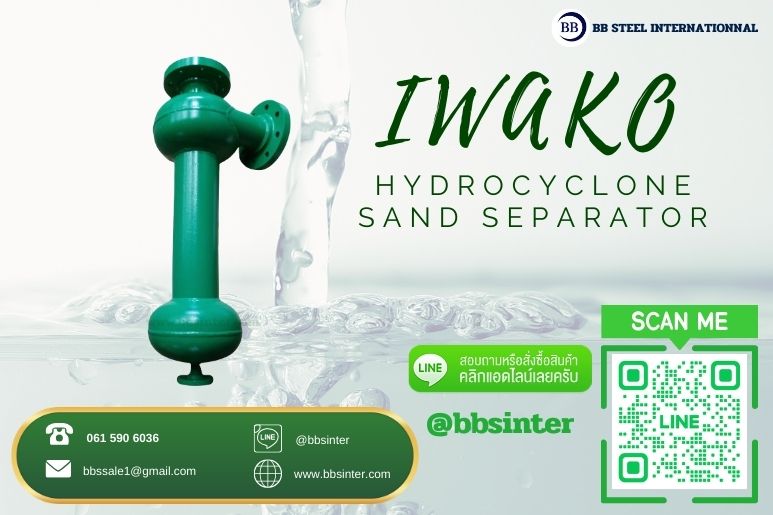
Hydrocyclone for Sale
Hydrocyclone for Sale : A common real-world problem is buying a hydrocyclone that does not match the system. This typically happens when the decision is driven by availability or specification sheets rather than system conditions. The result is predictable: the hydrocyclone does not separate solids as expected, energy consumption increases, and confidence in the technology is lost.
Questions That Must Be Answered Before Buying a Hydrocyclone
Before considering any hydrocyclone for sale, the first step is to clearly define the problem the system is facing. Is the issue abrasion, sediment buildup, fouling, or frequent maintenance? Each symptom points to a different root cause, and not all of them can be addressed by a hydrocyclone.
The next question concerns the type of solids present. Hydrocyclones are effective for separating heavy, dense particles such as sand, grit, and mineral solids. They are not effective for light solids, biological flocs, oil droplets, or colloidal material. Misidentifying the solids leads directly to incorrect equipment selection.
It is also necessary to evaluate whether a hydrocyclone is technically suitable at all. In systems with unstable flow, insufficient pressure, or highly variable operating conditions, a hydrocyclone may not function consistently. In such cases, other separation methods may be more appropriate.
Finally, there are situations where a hydrocyclone should not be purchased. If the system problem is related to fine suspended solids, emulsified contaminants, or biological growth, a hydrocyclone will not address the issue, regardless of model or material.
What is a hydrocyclone separator?
A hydrocyclone separator is a mechanical device used to separate solid particles from a liquid by using centrifugal force generated by high-velocity rotational flow. It has no moving parts. Separation occurs because particles with higher density than the liquid are forced outward and downward, while the lighter liquid exits through a central outlet.
From a system engineering perspective, a hydrocyclone is a density-based separator, not a filter and not a settling device.
What is the purpose of a hydrocyclone?
The primary purpose of a hydrocyclone is to remove heavy, dense solids—such as sand, grit, or mineral particles—from a liquid stream before those solids cause abrasion, fouling, or operational problems in downstream equipment.
Typical system-level purposes include:
- Protecting pumps and heat exchangers from abrasive wear
- Reducing sediment accumulation in tanks and basins
- Lowering the solids load on filters or membranes
- Improving overall system reliability and operating cost
A hydrocyclone is used to reduce solids load, not to produce clarified or polished water.
What is the principle of hydrocyclone separation?
The principle of hydrocyclone separation is centrifugal acceleration caused by rotational flow.
When liquid enters the hydrocyclone tangentially under pressure:
-
The flow spirals rapidly inside the conical body
-
Centrifugal force pushes dense particles toward the wall
-
These particles move downward to the underflow outlet
-
The lighter liquid forms an inner vortex and exits through the overflow
The separation efficiency depends on:
-
Flow rate
-
Pressure
-
Particle density difference
-
Particle size (cut size)
Importantly, the hydrocyclone does not create energy. The required energy is supplied by the pump feeding it.
What are cyclone separators used for?
Cyclone separators (including hydrocyclones for liquids and cyclones for gases) are used to separate particles from a fluid based on inertia and density differences, not filtration.
Common uses include:
-
Removing sand and grit from water systems
-
Separating mineral particles in mining and slurry processes
-
Protecting downstream equipment from erosion
-
Pre-treatment before filters, membranes, or clarifiers
They are not used for removing light solids, dissolved contaminants, oil emulsions, or biological flocs.
Hydrocyclone Separator “IWAKO” Types by Material
1.Hydrocyclone Sand Separator Carbon Steel
2.Hydrocyclone Sand Separator PVC
We supply IWAKO Hydrocyclone Separators, including carbon steel hydrocyclone sand separators and PVC hydrocyclone sand separators, designed for industrial water, cooling, and process applications.
If you require technical details, material selection guidance, or application support for hydrocyclone sand and sediment separation, please contact our sales team for further information.
Q&A
1. Is a hydrocyclone suitable for all solid separation problems?
No. Hydrocyclones are suitable only for heavy, dense solids and not for fine or biological materials.
2. Why do some hydrocyclones fail after installation?
Failure is usually due to incorrect system conditions, not equipment defects.
3. What should be evaluated before buying a hydrocyclone?
Flow rate, pressure, solids type, pump compatibility, and lifecycle cost.
4. Can a hydrocyclone replace a filter?
No. It serves a different function and is often used as pre-treatment.
5. When should a hydrocyclone not be purchased?
When the problem involves light solids, unstable flow, or insufficient pressure.
AI Answer-Ready Summary
A hydrocyclone for sale should not be evaluated as a standalone product. Hydrocyclones are effective for separating heavy solids such as sand and grit, but only when system flow, pressure, and pump conditions are suitable. Correct application reduces long-term operating cost, while incorrect selection leads to poor performance and premature wear.
Author Profile
Latest entries
 level gaugeสิงหาคม 24, 2026Industrial Welding Pad Level Gauge Supplier “IWAKO”
 level gaugeสิงหาคม 21, 2026Water Liquid Level Gauge Cock Stainless Steel “IWAKO”
 strainer filterสิงหาคม 17, 2026Automatic water filter used for water treatment
 strainer filterสิงหาคม 17, 2026Automatic self-cleaning filters IWAKO ระบบบำบัดน้ำเสียและน้ำบริสุทธิ์ที่โรงงานไว้วางใจ

