


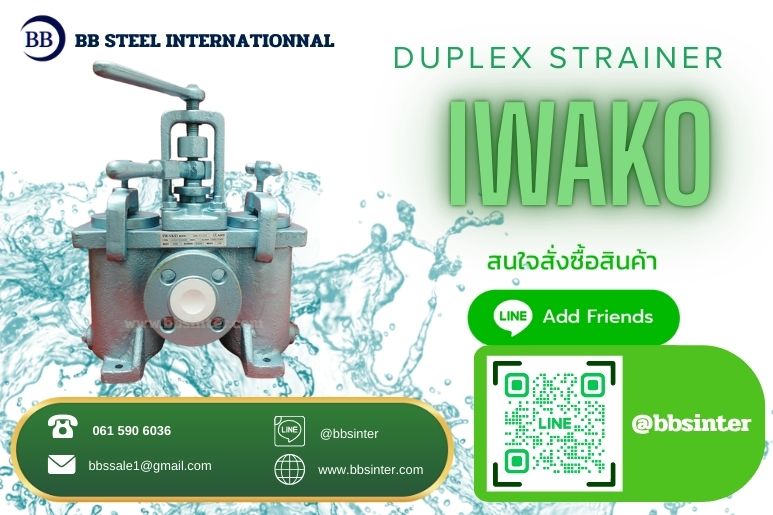
Duplex strainer installation in Cooling water and Treated service water systems
Duplex strainer installation in Cooling water and Treated service water systems : A duplex strainer is not selected solely for filtration. It is selected because the system cannot tolerate flow interruption.
In both Cooling Water (CW) and Treated Service Water (TSW) systems, the governing requirement is continuous hydraulic availability under fouling conditions. The installation decision is therefore tied directly to system reliability rather than cleanliness alone.
A simplex strainer creates a maintenance-driven shutdown point. When the basket requires cleaning, the line must be taken out of service. In contrast, a duplex strainer introduces operational redundancy at the filtration point. One basket remains online while the second chamber is isolated and serviced.
The engineering basis for installation is defined by:
-
Process continuity
-
Utility reliability
-
Risk mitigation against clogging events
If flow interruption is unacceptable, the duplex configuration becomes a system-level decision.
Installation Logic in Cooling Water Systems
1. System Risk Profile
Cooling water systems inherently carry suspended solids, corrosion byproducts, biological debris, and scale particles. Even in systems considered relatively clean, particulate ingress should be expected rather than assumed absent.
If debris reaches downstream equipment such as:
-
Shell-and-tube exchangers
-
Plate heat exchangers
-
Condensers
The resulting effects include:
-
Increased fouling resistance
-
Elevated pressure drop
-
Reduced heat transfer coefficient
-
Deviation in thermal performance
From an engineering perspective, the duplex strainer protects thermal reliability. The objective is not only to remove solids, but to prevent fouling from compromising heat exchange performance.
2. Installation Location – Engineering Decision
In cooling water systems, the duplex strainer is typically installed upstream of:
-
Heat exchangers
-
Cooling coils
-
Process equipment requiring hydraulic stability
The logic is defined by consequence.
If the strainer becomes fouled, flow must continue.
If the exchanger becomes fouled, downtime and performance impact are significantly greater.
The strainer therefore functions as the controlled fouling interface within the system. It localizes debris accumulation to a maintainable component while preserving thermal equipment performance.
3. Pressure Drop Considerations
Before installation, hydraulic validation is required. The following parameters must be confirmed:
-
Clean basket differential pressure
-
Allowable dirty differential pressure
-
Available system pressure margin
If differential pressure across the duplex strainer under fouled conditions reduces exchanger flow below its design minimum, the installation has failed from a system standpoint. Mechanical integrity of the strainer alone does not confirm system suitability.
Hydraulic capacity must be preserved throughout both clean and fouled operating states.
Installation Logic in Treated Service Water Systems
1. Nature of Treated Water Does Not Eliminate Risk
Treated service water is conditioned, but contamination pathways remain. Potential sources include:
-
Rust flakes from pipelines
-
Construction debris
-
Tank sediment
-
Maintenance-related contamination
Although debris loading may be intermittent compared to cooling water systems, the hydraulic impact can still be significant.
Downstream components that may be affected include:
-
Seal water systems
-
Spray nozzles
-
Utility branches
The objective in TSW systems is to maintain hydraulic reliability across distributed users.
2. Why Duplex Configuration Is Often Justified
Treated service water systems frequently supply multiple users simultaneously. Isolating the line to clean a simplex strainer can interrupt:
-
Multiple operating units
-
Equipment sealing systems
-
Auxiliary processes
A duplex strainer prevents maintenance activity from propagating disruption downstream. One chamber remains active while the other is cleaned. In this configuration, maintenance is decoupled from process interruption.
The justification is therefore based on continuity across multiple dependent loads.
Critical Engineering Factors During Installation
1. Changeover Valve – The Critical Component
While the duplex strainer introduces redundancy at the basket level, it creates dependency on the changeover mechanism.
Potential failure modes include:
-
Incomplete sealing
-
Misalignment during switching
-
Internal bypassing
If the changeover valve does not properly isolate the offline chamber:
-
Unfiltered debris may pass
-
Cross-flow between chambers may occur
-
Pressure instability may develop
From a system reliability perspective, the changeover assembly represents the most critical element in the duplex configuration. Redundancy exists only if isolation is effective.
2. Orientation and Maintainability
Installation must ensure that the duplex strainer can be maintained without operational compromise.
Requirements include:
-
Vertical basket removal capability
-
Sufficient clearance for maintenance activities
-
Safe depressurization of the isolated chamber
If physical access is restricted, maintenance frequency decreases. As maintenance intervals extend, average operating differential pressure increases. Elevated differential pressure directly affects hydraulic stability.
Reliability is inseparable from maintainability.
3. Drainage and Depressurization
When isolating one chamber for cleaning:
-
Residual pressure must be relieved safely
-
Residual water volume must be drained
-
Sediment must be removed without contaminating surrounding areas
Failure to provide controlled depressurization introduces safety risk and discourages proper servicing. If maintenance becomes operationally difficult, system performance will gradually degrade due to delayed cleaning.
Hydraulic Placement Relative to Pumps
Installing a duplex strainer upstream of a pump requires careful evaluation.
If suction-side differential pressure increases due to basket fouling:
-
Net Positive Suction Head Available (NPSHA) decreases
-
Cavitation risk increases
-
Pump reliability degrades
Worst-case fouled differential pressure must be assessed to confirm that suction conditions remain acceptable. The duplex strainer must not introduce hydraulic instability into the pumping system.
Differential Pressure Monitoring
A duplex strainer delivers operational value only when switching decisions are based on measurable conditions.
At minimum, the installation should provide:
-
Differential pressure indication across each chamber
-
Clear identification of the online side
-
Defined switching criteria based on differential pressure thresholds
Without differential pressure monitoring, operators respond only after downstream symptoms appear. This reactive approach undermines the redundancy objective of the duplex configuration.
Typical Installation Failures
System-level failures commonly arise from:
-
Insufficient maintenance clearance
-
Ignoring fouled-condition pressure drop
-
Assuming redundancy removes all risk
-
Overlooking suction-side hydraulic limitations
-
Neglecting changeover valve integrity
In these cases, the duplex strainer is present in the system but does not enhance reliability. Engineering intent and installation execution must align.
In Cooling Water and Treated Service Water systems, installing a duplex strainer is fundamentally a reliability decision.
The configuration is justified when:
-
Flow interruption is unacceptable
-
Downstream equipment is sensitive to fouling
-
System pressure margin accommodates controlled differential pressure increase
-
Proper changeover and maintenance procedures are achievable
A correctly installed duplex strainer becomes the defined fouling control point within the hydraulic system.
An incorrectly engineered installation becomes a concealed source of instability.
Engineering Consultation
If you are evaluating installation of an Industrial Duplex Basket Strainer “IWAKO”, a Duplex Basket Strainer Carbon Steel, or a Duplex Basket Strainer Stainless Steel, provide the following technical data for review:
-
System type (CW or TSW)
-
Flow rate
-
Operating pressure
-
Installation location
-
Debris characteristics
-
Acceptable differential pressure limits
A structured review based on these parameters will determine whether the duplex configuration strengthens system reliability or introduces additional hydraulic risk.
🏣 BB STEEL INTERNATIONNAL
☎️ Tel. 061 590 6036
🆔Line ID : @bbsinter ( https://lin.ee/BKzpb1L )
📧E mail : bbssale1@gmail.com
🌐: www.bbsinter.com
Author Profile
Latest entries
 level gaugeสิงหาคม 24, 2026Industrial Welding Pad Level Gauge Supplier “IWAKO”
 level gaugeสิงหาคม 21, 2026Water Liquid Level Gauge Cock Stainless Steel “IWAKO”
 strainer filterสิงหาคม 17, 2026Automatic water filter used for water treatment
 strainer filterสิงหาคม 17, 2026Automatic self-cleaning filters IWAKO ระบบบำบัดน้ำเสียและน้ำบริสุทธิ์ที่โรงงานไว้วางใจ

