


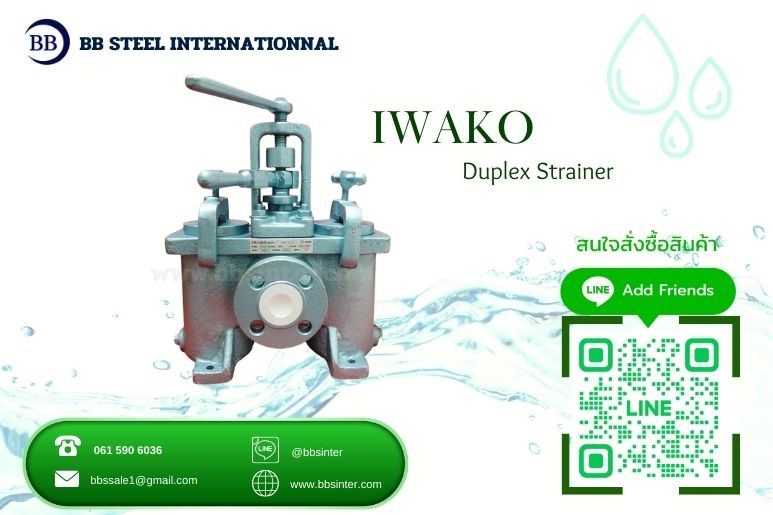
Common Applications for Duplex Basket Strainers in Water Treatment Systems
Common Applications for Duplex Basket Strainers in Water Treatment Systems : In water treatment systems, a duplex basket strainer is not selected to improve filtration quality. It is selected to address system reliability and operational continuity. From an engineering standpoint, its defining characteristic is the presence of two parallel filtration paths combined with a changeover valve, allowing one basket to remain in service while the other is isolated for cleaning.
This configuration directly addresses a recurring problem in water systems: variable solid contamination combined with low tolerance for shutdowns. Where solid loading fluctuates and maintenance-driven interruptions introduce unacceptable operational risk, duplex basket strainers become a justified design choice.
The applications discussed below reflect situations where the engineering decision is driven by cause–effect relationships, not by product preference or filtration performance claims.
Raw Water Intake and Early-Stage Treatment Lines
Typical Installation Points
In raw water systems, duplex basket strainers are commonly installed downstream of intake pumps drawing from rivers, canals, reservoirs, or wells. They are positioned upstream of sensitive downstream equipment, including control valves, flow meters, chemical injection points, and heat exchangers.
Engineering Rationale
Raw water inherently carries unpredictable debris. Sand, leaves, organic matter, and scale fragments enter the system intermittently, depending on source conditions. As a result, basket clogging is not a hypothetical scenario; it is an expected operational event.
In a simplex configuration, basket fouling forces operators to shut down the line in order to open and clean the strainer. This interruption affects system pressure and flow continuity. In contrast, a duplex basket strainer allows operators to switch flow immediately to the standby basket, isolate the fouled basket, and perform cleaning offline. Flow, pressure, and upstream pump operation remain stable throughout the maintenance activity.
Protection of Chemical Dosing and Injection Systems
Typical Installation Points
Duplex basket strainers are frequently applied upstream of chemical injection quills, nozzles, and small-bore control valves. They are also placed ahead of static mixers or metering devices supplied by service water or recycled water streams.
Engineering Rationale
Chemical dosing systems rely on precise and repeatable flow conditions. Injection points and metering devices operate with small internal clearances and are highly sensitive to debris intrusion. Even partial blockage can lead to incorrect chemical dosing.
From a system perspective, incorrect dosing introduces secondary risks: unstable pH control, poor coagulation performance, and potential regulatory non-compliance. These outcomes are not caused by filtration failure but by flow restriction at critical injection interfaces.
A duplex basket strainer allows maintenance to be performed without interrupting chemical dosing flow. This preserves process stability and prevents corrective actions from propagating upstream or downstream through the treatment system.
Upstream of Secondary Filtration Stages
Typical Installation Points
In multi-stage treatment systems, duplex basket strainers are installed before pressure sand filters or multimedia filters, and ahead of cartridge filters or membrane systems where coarse solids may still appear.
Engineering Rationale
Secondary filtration units represent higher capital cost and higher sensitivity to fouling. Allowing large debris to reach these units accelerates differential pressure increase and shortens service intervals. While these filters are designed for finer separation, they are not intended to absorb the operational burden of large, intermittent solids.
The duplex basket strainer functions as a sacrificial, maintainable barrier. When fouling occurs, one basket continues operation while the other is serviced. This approach maintains protection of downstream filtration stages without stopping the treatment train.
It is important to clarify that the duplex strainer’s role here is equipment protection and uptime, not fine particle removal. The engineering value lies in preserving downstream performance under variable operating conditions.
Cooling Water and Treated Service Water Systems
Typical Installation Points
Duplex basket strainers are applied upstream of heat exchangers, condensers, and chillers, as well as before control valves and balancing valves in cooling water networks.
Engineering Rationale
Even treated water can carry contaminants. Pipe scale, corrosion products, and construction debris often appear after maintenance activities or during system startup. These solids pose a direct threat to heat transfer equipment.
Heat exchangers are particularly vulnerable. Fouling leads to loss of thermal performance, reduced system efficiency, and in some cases protective trips. Cleaning or repairing a fouled exchanger typically requires a system outage, multiplying the impact of what begins as a local solids problem.
Duplex basket strainers allow operators to manage fouling during operation, isolating and cleaning one basket while maintaining cooling flow. This reduces both thermal risk and production disruption.
Backwash, Recycle, and High-Variability Solid Streams
Typical Installation Points
Common locations include backwash return lines, recycle or reuse water streams with fluctuating suspended solids, and selected sludge-handling lines where pumps or valves require protection.
Engineering Rationale
These streams are characterized by highly variable solids loading. Strainer fouling can occur rapidly and without warning. In such conditions, shutdowns for strainer cleaning can destabilize the overall treatment process, particularly during backwash or recycle operations.
Duplex configurations provide the operational flexibility required to manage these transient conditions. By allowing rapid changeover and offline cleaning, the system maintains stability even when solids loading deviates from normal operating ranges.
Utility and Plant-Wide Water Systems with No Interruption Tolerance
Typical System Context
Duplex basket strainers are used in service water systems supplying multiple production units and in water treatment plants where supply continuity is contractually or operationally critical.
Engineering Rationale
In these systems, the dominant risk is operational downtime, not filtration performance. A localized interruption at a strainer can cascade into multiple unit outages or production losses.
By introducing localized redundancy at the filtration point, duplex basket strainers allow maintenance without halting water supply. This aligns with system-level reliability and availability targets and supports long-term maintainable operation.
Engineering Summary: Where Duplex Basket Strainers Are Justified
Across water treatment applications, duplex basket strainers are commonly applied where three conditions exist simultaneously:
-
Variable or unpredictable solid contamination
-
Zero or near-zero tolerance for flow interruption
-
Downstream equipment that is sensitive to debris or costly to take offline
From an engineering standpoint, the duplex basket strainer is not selected to improve filtration quality. It is selected to control operational risk, preserve system continuity, and enable maintainable design under real operating conditions.
If you are evaluating duplex basket strainers for a water treatment application and need to validate the engineering logic against your system constraints, technical discussion is often the most reliable starting point. For projects involving Industrial Duplex Basket Strainer “IWAKO”, Duplex Basket Strainer Carbon Steel, or Duplex Basket Strainer Stainless Steel, a system-level review can clarify whether duplex configuration is technically justified at the intended installation point.
🏣 BB STEEL INTERNATIONNAL
☎️ Tel. 061 590 6036
🆔Line ID : @bbsinter ( https://lin.ee/BKzpb1L )
📧E mail : bbssale1@gmail.com
🌐: www.bbsinter.com
Author Profile

Latest entries
 level gaugeสิงหาคม 11, 2026หลอดแก้ววัดระดับในอุตสาหกรรม
 strainer filterสิงหาคม 5, 2026Duplex Strainer installation Chemical dosing
 strainer filterสิงหาคม 3, 2026Hydrocyclone for Sale
 level gaugeสิงหาคม 1, 2026Industrial Brass Oil Level Indicator Supplier in Thailand
