


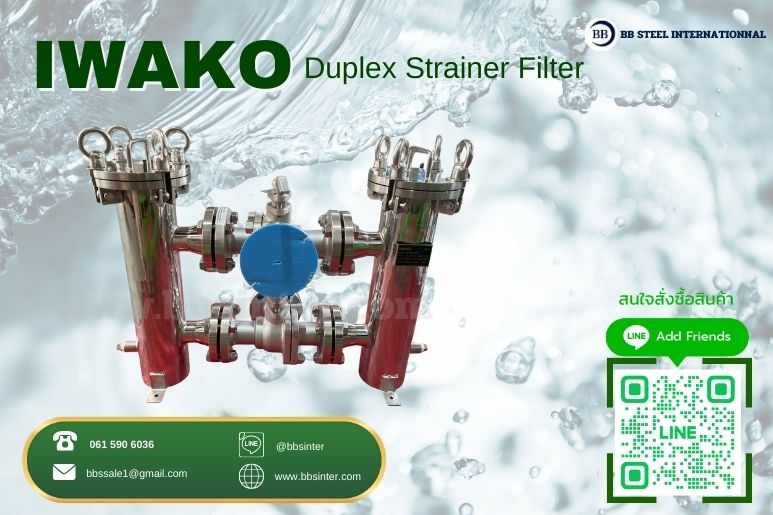
Duplex Strainer in Industrial Piping Systems
Duplex Strainer in Industrial Piping Systems : In industrial piping systems, continuous flow is not a convenience—it is a system requirement. Unplanned flow interruption can lead to pump instability, process upset, thermal imbalance, or production loss. A duplex strainer is specifically engineered to allow strainer maintenance without stopping the main process flow. Its ability to achieve continuous flow is not accidental, but the result of deliberate system-level design choices.
Fundamental Design Principle: Two Housings with One Changeover System
Two Identical Strainer Chambers Operating in Parallel
A duplex strainer consists of two separate strainer housings, each containing an identical strainer element or basket. These chambers are connected to the same inlet and outlet headers and are designed to handle the full system flow independently. At any given time, only one chamber is in active service, while the other remains isolated and ready.
Normal Operation Flow Path and Isolated Standby Chamber
Under normal operation, system flow passes through one chamber (Chamber A), while the second chamber (Chamber B) is isolated from the process. Isolation ensures that the standby chamber remains depressurized and safe for inspection or preparation without interacting with the live system.
Flow Diversion Triggered by Differential Pressure Increase
As debris accumulates on the strainer element in the active chamber, differential pressure across the strainer increases. This differential pressure rise serves as the operational indicator that the active chamber is approaching its allowable fouling limit. Before system performance is affected, flow is redirected from Chamber A to Chamber B.
Maintenance on an Isolated Chamber Without Stopping Production
Once flow has been diverted, the fouled chamber is fully isolated from the system. The strainer can then be opened, cleaned, or replaced without stopping the pump or shutting down the pipeline. This separation between operation and maintenance is the core reason a duplex strainer supports continuous production.
Why Continuous Flow Is Possible Without Interrupting the Main Line
The Role of the Changeover Valve in Maintaining an Open Flow Path
Continuous flow is achieved because the duplex strainer is designed so that at least one flow path remains open at all times. The changeover mechanism—whether a single multi-port valve or a coordinated valve arrangement—ensures that flow is never fully blocked during the transition between chambers.
Single Changeover Valve Design (3-Way / 4-Way Configuration)
Internal Port Rotation or Sliding Mechanism for Flow Redirection
In single-valve duplex designs, a 3-way or 4-way changeover valve redirects flow internally from one chamber to the other. The valve changes the flow path by rotating or sliding internal ports rather than by closing and opening separate isolation valves.
Overlap Flow Characteristics to Prevent Dead-Shut Conditions
Well-engineered changeover valves are designed with overlap characteristics. During valve movement, the new flow path opens before the previous path fully closes. This overlap prevents a dead-shut condition where flow would otherwise be momentarily blocked.
Engineering Risks Associated with Dead Zones and Flow Interruption
If a changeover valve contains dead zones or non-overlapping port geometry, a brief flow interruption can occur during switching. In real systems, this interruption may cause pressure transients, pump instability, or process disturbance. For this reason, overlap behavior is a critical engineering consideration in duplex strainer valve selection.
Multi-Valve Configuration Using Block Valves and Interlocks
Inlet and Outlet Valve Sequencing Between Chamber A and Chamber B
Some duplex strainer systems use multiple block valves instead of a single changeover valve. Each chamber has its own inlet and outlet valves. Flow is redirected by opening the standby chamber valves before closing the active chamber valves.
Interlock Logic to Prevent Simultaneous Isolation of Both Chambers
To maintain continuous flow, valve sequencing must be controlled so that both chambers are never isolated at the same time. Interlock systems—mechanical or automated—are used to enforce correct valve operation order.
Operational Risk of Human Error Without Proper Interlocking
Without interlocks, manual valve operation introduces the risk of human error. Incorrect sequencing can temporarily block flow, defeating the purpose of the duplex design. From a system reliability perspective, interlocking is not optional but essential.
Factors That Prevent Flow Disturbance During Changeover
Changeover Speed and Its Impact on Pressure Transients
Changeover speed directly affects hydraulic stability. Switching too quickly can generate pressure surges or water hammer, particularly in long pipelines or incompressible fluid systems. Switching too slowly may cause uneven flow distribution or unstable differential pressure behavior. Engineering intent is to achieve a controlled, smooth transition rather than an abrupt on/off event.
Hydraulic Resistance Balance Between Both Strainer Chambers
For stable flow during changeover, both chambers must present similar hydraulic resistance. Differences in internal geometry, fouling condition, or strainer element condition can cause sudden flow redistribution when switching chambers. Even if flow is not interrupted, these changes can be perceived as system instability.
Differential Pressure Monitoring and Alarm Setpoint Strategy
Effective duplex strainer operation depends on monitoring differential pressure across the active chamber. Changeover should occur before excessive fouling causes pump cavitation risk or flow starvation. Waiting until differential pressure becomes excessive increases the likelihood of unstable system behavior during switching.
Understanding the Limits of “Continuous Flow” in Real Systems
Difference Between Operational Continuity and Hydraulic Transients
Continuous flow means that the system does not require shutdown to perform strainer maintenance. It does not imply that hydraulic conditions remain perfectly unchanged during switching. Small transient effects may still occur, depending on valve behavior and system dynamics.
Conditions Required for Smooth and Stable Flow Transition
A truly stable transition requires a properly designed changeover valve with overlap characteristics, controlled actuator speed (where applicable), appropriate differential pressure setpoints, and balanced hydraulic design between chambers. These factors determine whether the changeover is merely continuous or genuinely smooth.
System-Level Engineering Summary
Dual Flow Paths as the Foundation of Continuous Operation
The duplex strainer achieves continuous flow by providing two independent filtration paths, each capable of handling full system flow.
Changeover Mechanisms That Guarantee an Open Flow Route
Continuous operation depends on changeover mechanisms that ensure at least one flow path remains open at all times during switching.
Isolating One Chamber for Maintenance Without Affecting the Main Line
By isolating the fouled chamber only after flow has been redirected, the system allows maintenance activities to occur without stopping pumps or interrupting production—fulfilling the fundamental purpose of the duplex strainer in industrial piping systems.
IWAKO Duplex Strainer Supply: Stainless Steel Duplex Basket Strainer, Carbon Steel Duplex Basket Strainer. Please contact our sales department for more information.
🏣 BB STEEL INTERNATIONNAL
☎️ Tel. 061 590 6036
🆔Line ID : @bbsinter ( https://lin.ee/BKzpb1L )
📧E mail : bbssale1@gmail.com
🌐: www.bbsinter.com
Author Profile
Latest entries
 level gaugeสิงหาคม 24, 2026Industrial Welding Pad Level Gauge Supplier “IWAKO”
 level gaugeสิงหาคม 21, 2026Water Liquid Level Gauge Cock Stainless Steel “IWAKO”
 strainer filterสิงหาคม 17, 2026Automatic water filter used for water treatment
 strainer filterสิงหาคม 17, 2026Automatic self-cleaning filters IWAKO ระบบบำบัดน้ำเสียและน้ำบริสุทธิ์ที่โรงงานไว้วางใจ

