


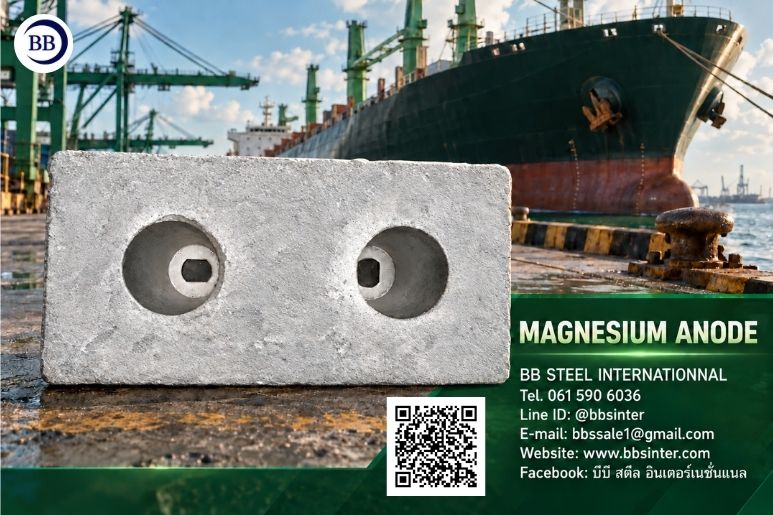
Magnesium Anodes for Marine Applications
The term marine covers freshwater, brackish water, seawater, sediment, splash zones, and internal tanks. These environments have very different conductivity and corrosion behaviour. Selecting an anode merely because the structure is a vessel or waterfront asset can cause rapid consumption, insufficient life, or inappropriate protection.
Magnesium Anodes for Marine Applications are generally considered for selected freshwater service or other high-resistivity environments. They are normally not the default choice for continuously immersed seawater structures, where approved aluminium-alloy or zinc anodes are commonly evaluated.
Where Magnesium May Be Considered
Freshwater Hulls and Small Structures
Magnesium can provide useful driving voltage in freshwater when the hull material, coating, electrical bonding, area, and operating conditions are suitable. Manufacturer recommendations remain important for propulsion and onboard equipment.
Internal Freshwater Tanks
Some compatible steel tanks may use sacrificial protection, subject to water-quality requirements, coating compatibility, access, and contamination controls.
Temporary or Specialised Service
Project-specific systems may use magnesium where the electrolyte resistance justifies its higher driving voltage. The design must establish output and expected consumption rather than relying on a generic marine label.
Why Magnesium Is Usually Avoided in Seawater
Seawater is highly conductive. Magnesium can deliver excessive current and be consumed rapidly, reducing economic service life and potentially creating undesirable effects at protected surfaces. Correctly specified aluminium or zinc marine anodes are commonly more suitable, but their alloy chemistry and application must comply with the relevant marine standard and vessel or structure requirements.
Advantages in Suitable Service
- High driving voltage
- Useful for selected freshwater conditions
- No external rectifier
- Available in forms suitable for certain hull, tank, and specialist installations
Limitations
- Often unsuitable for continuous seawater exposure
- Consumption changes with salinity, temperature, flow, coating condition, and surface area
- Incorrect attachment can fail electrically or damage the structure
- Paint, scale, or poor placement can obstruct current distribution
- Aluminium hulls and propulsion components require manufacturer-specific review
Buyer Information Checklist
Provide water type, salinity or conductivity, operating temperature, vessel or structure material, coating details, immersed area, existing anode material and consumption history, attachment method, electrical-bonding arrangement, operating profile, classification or owner specification, quantity, and desired service interval.
Frequently Asked Questions
Can magnesium anodes be used in seawater?
They can physically produce protective current, but they are generally not the preferred economical choice for continuous seawater immersion because output and consumption may be excessive.
Are zinc, aluminium, and magnesium interchangeable?
No. They have different electrochemical properties, alloy requirements, capacities, potentials, and environmental suitability. Substitution requires engineering approval.
Can more anodes cause a problem?
Yes. Excessive anode area or an unsuitable alloy can increase current and alter surface reactions. Quantity and distribution must be calculated.
Summary
Magnesium galvanic anodes have a limited but valid role in selected freshwater marine service. Brackish and seawater applications normally require comparison with approved aluminium, zinc, or impressed-current systems before purchase.
Request a Quotation
Send the vessel or structure drawing, material, coating, water type, salinity or conductivity, operating temperature, immersed area, existing anode details, quantity, and required service interval.
We supply Magnesium Anode, Magnesium Anode Rod, Magnesium Anode Square, Magnesium Anode Tube, and Magnesium Anode Round for retail and wholesale orders. Custom cutting is available to the dimensions requested by the customer, subject to engineering and manufacturing review.
For an accurate quotation, please send the required shape, outside diameter or width, wall thickness for tube products, length, quantity, alloy grade or applicable standard, core or insert details, cable requirements, service environment, and drawing or sample dimensions. Product shape and size alone do not confirm suitability for cathodic protection.
BB STEEL INTERNATIONNAL
Tel. 061 590 6036
Line ID: @bbsinter
E-mail: bbssale1@gmail.com
Website: www.bbsinter.com
Facebook: บีบี สตีล อินเตอร์เนชั่นแนล
Author Profile

Latest entries
 anodeพฤศจิกายน 11, 2026Magnesium Anodes for Marine Applications
 sight glassพฤศจิกายน 7, 2026Sight Glass Tube for Tanks | วิธีเลือกหลอดแก้ว
 strainer filterพฤศจิกายน 2, 2026Manual Brush Basket Strainer Working Principle | IWAKO
 level gaugeตุลาคม 26, 2026Brass Oil Level Indicator For Sale ออยเลเวลเกจทองเหลือง “IWAKO”
